


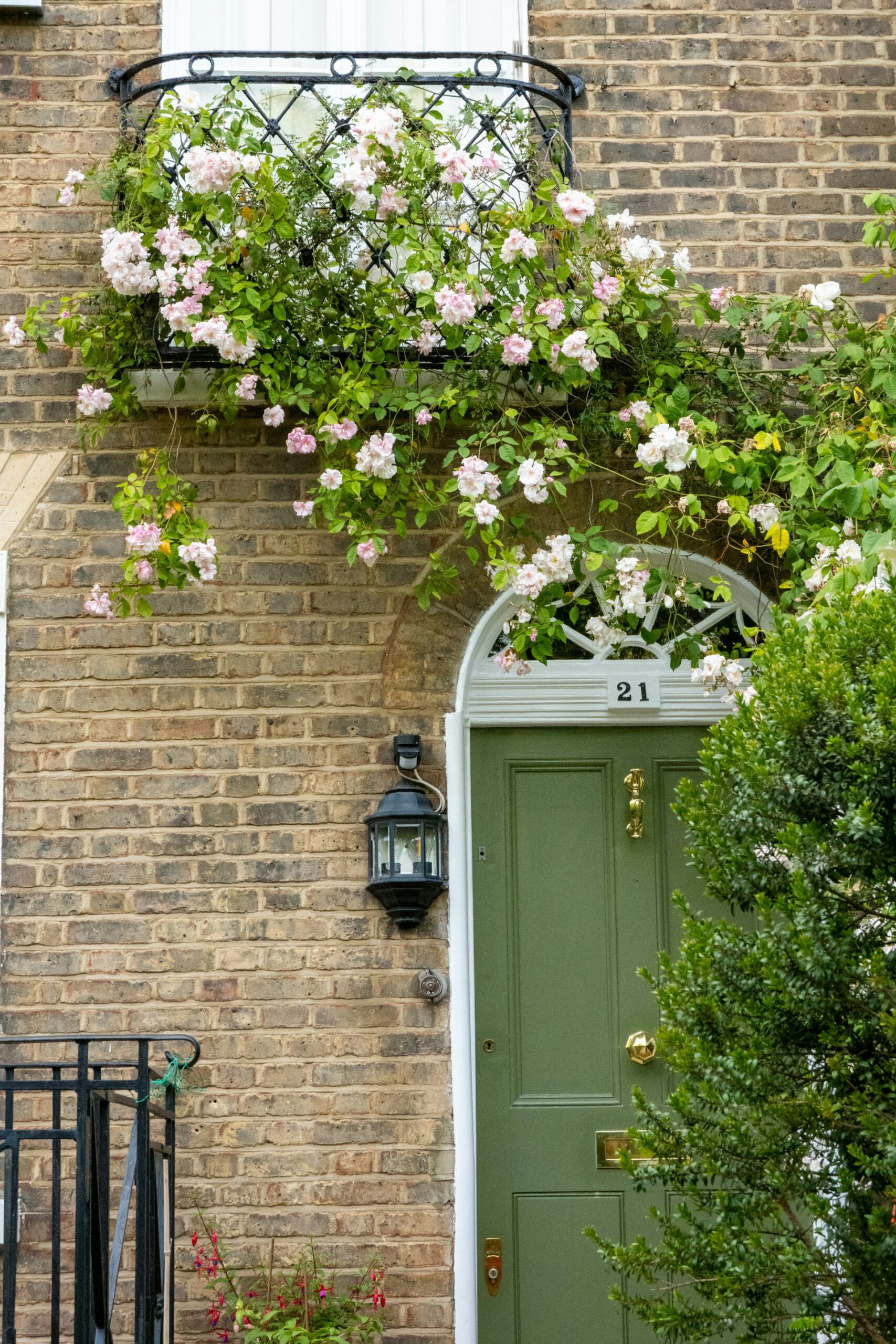
You have a small front yard, a front door, and just enough room for a garden.
You’d love flowers spilling over a pathway. Maybe a climbing rose beside the entrance. A little bench where you could sit with your morning coffee.
Perhaps you’d like to grow a few herbs or vegetables among the flowers, too.
But how do you bring all those lovely ideas together without making your little front yard feel crowded?
The secret is to give all that wonderful wildness a little structure.
First, Give Your Cottage Garden Some Bones
Cottage gardens have a reputation for being wonderfully unruly. Flowers tumble over pathways, roses climb around doorways, and vegetables grow happily among ornamentals.
That informality is part of their charm.
But if I were designing a cottage garden in a small front yard, I wouldn’t begin by choosing the flowers. I’d begin by establishing the structure that allows all that exuberance to look beautiful rather than chaotic.
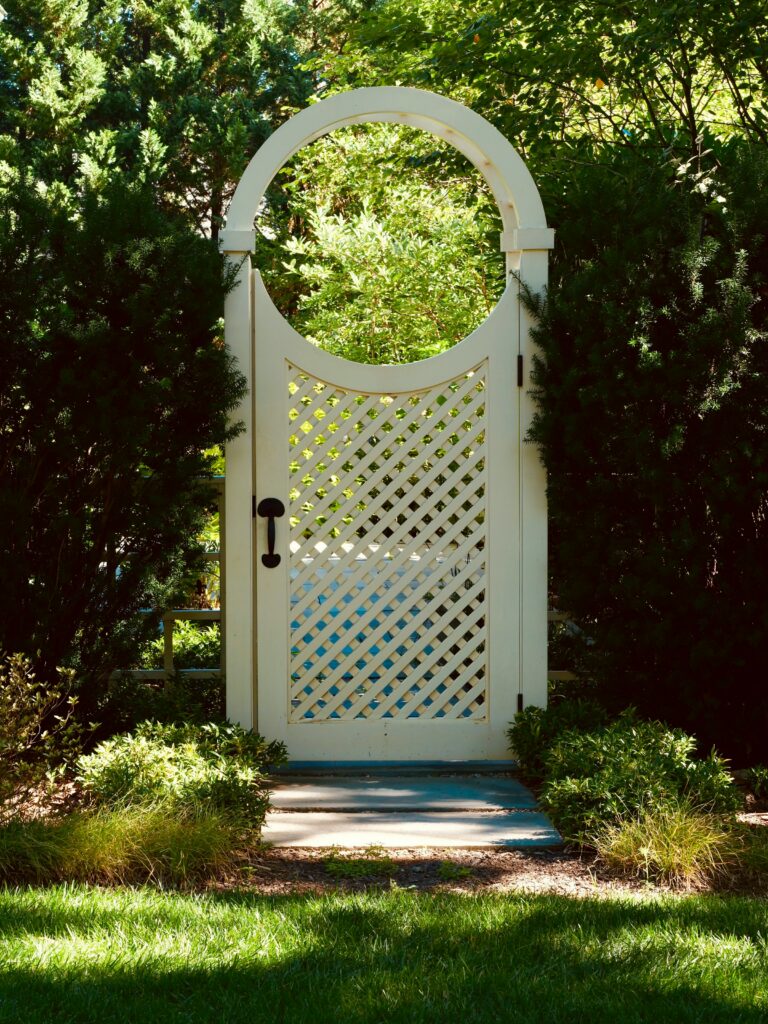
First, I’d look at what already exists.
Where does the front path lead? Is there a fence defining the property? Could a simple picket fence create a more inviting boundary? Would an arbor or climbing rose help frame the entrance?
These are the bones of the garden.
A straight brick walkway can be every bit as charming as a curved gravel path when it’s surrounded by flowers. A little picket fence gives climbing plants somewhere to grow and creates a beautiful contrast with loose, abundant planting.
I particularly love the combination of something architectural and something a little wild.
In a tiny garden, you don’t need all these features. You need just enough structure to give the planting somewhere to belong.
Once I’ve established the paths, entrances, boundaries, and possible vertical elements, I’d ask another important question.
How Much Food Do You Want to Grow?
One of my favorite things about traditional cottage gardens is that they weren’t created simply to look pretty.
They were productive spaces, where herbs, vegetables, fruit, and flowers grew together.
And there’s no reason a modern cottage garden can’t offer some of that same pleasure.
But the amount of food you want to grow will influence the layout.
Perhaps you simply want fresh herbs.
A little planting area near the path might be enough for rosemary, thyme, chives, or parsley, depending on your growing conditions. You could even use containers near the entrance.
Maybe you’d like vegetables mixed among the flowers.
You could introduce leafy greens, edible flowers, compact vegetables, or a few upright supports for climbing crops in sunny parts of the garden.
I particularly like the idea of productive plants becoming part of the ornamental composition rather than being confined to a separate vegetable patch.
Or perhaps growing food for your family is one of the garden’s main purposes.
In that case, I’d allocate the productive space before planning the ornamental borders.
Where will the vegetables get enough sunlight? Can you reach the beds for harvesting? Where might climbing crops grow vertically? How will you rotate or replace crops throughout the season?
A tiny front garden can produce a rewarding harvest, but the amount depends on the available growing space, climate, and what you choose to grow.
The important thing is to decide how much of your garden should be productive before you’ve filled every available inch with flowers.
Now Give the Planting Its Cottage Garden Character
Spencer Haynes
Once the layout and productive areas are established, this is where I’d begin having fun.
I love the abundance of a cottage garden, but personally, I prefer a little more structure beneath the wildness.
My approach would be to begin with a limited palette of colors and a handful of plants that look beautiful together.
That doesn’t mean every cottage garden needs to be color-coordinated. Traditional cottage gardens can be wonderfully colorful and spontaneous.
But in a tiny front yard, a more limited palette can help many different flowers feel like one composition.
Choose a Color Palette You Love
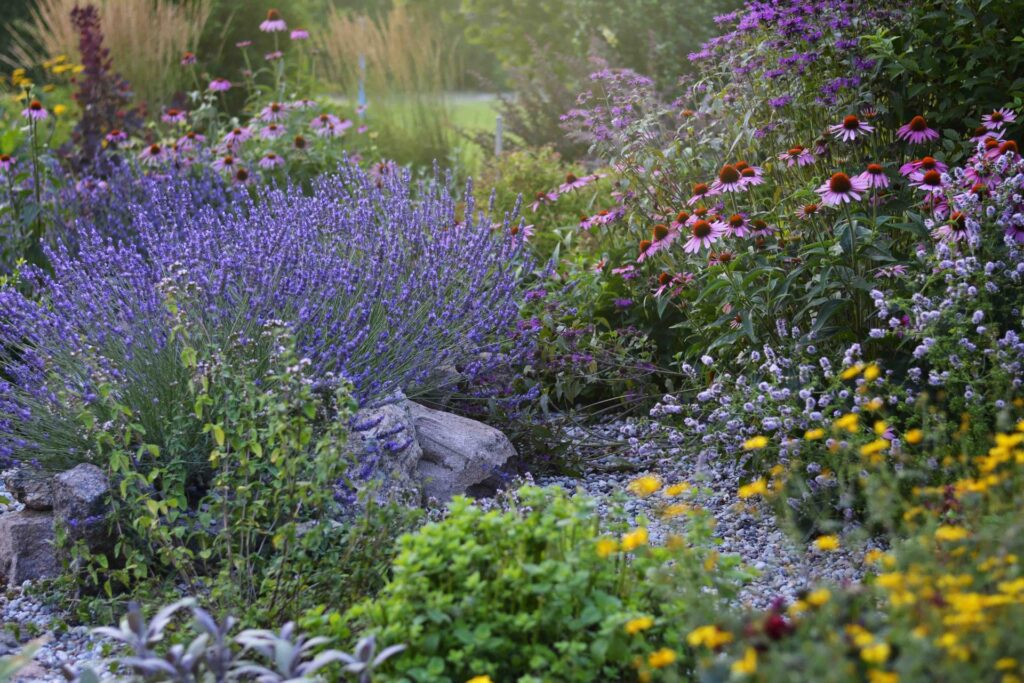
Perhaps you love pink, lavender, purple, and white.
Or maybe you’d prefer apricot, soft yellow, creamy white, and blue.
There’s no correct cottage garden palette. This is where your own taste comes in.
I’d choose a few colors that complement the house, the front door, and one another.
Then I’d look for plants that provide those colors at different times of year.
Build a Small Cast of Plants
Rather than shopping for one of everything, I’d begin with perhaps three to five flowering perennials that work beautifully together.
Then I’d consider whether the garden needs a few shrubs for structure.
You might combine flowering perennials with roses, a compact flowering shrub, or small evergreen shrubs that provide shape throughout the year.
You don’t need to include every plant category.
The important thing is that each plant contributes something to the overall composition.
Don’t Forget the Tall Flowers
Think about some of the cottage gardens you’ve admired.
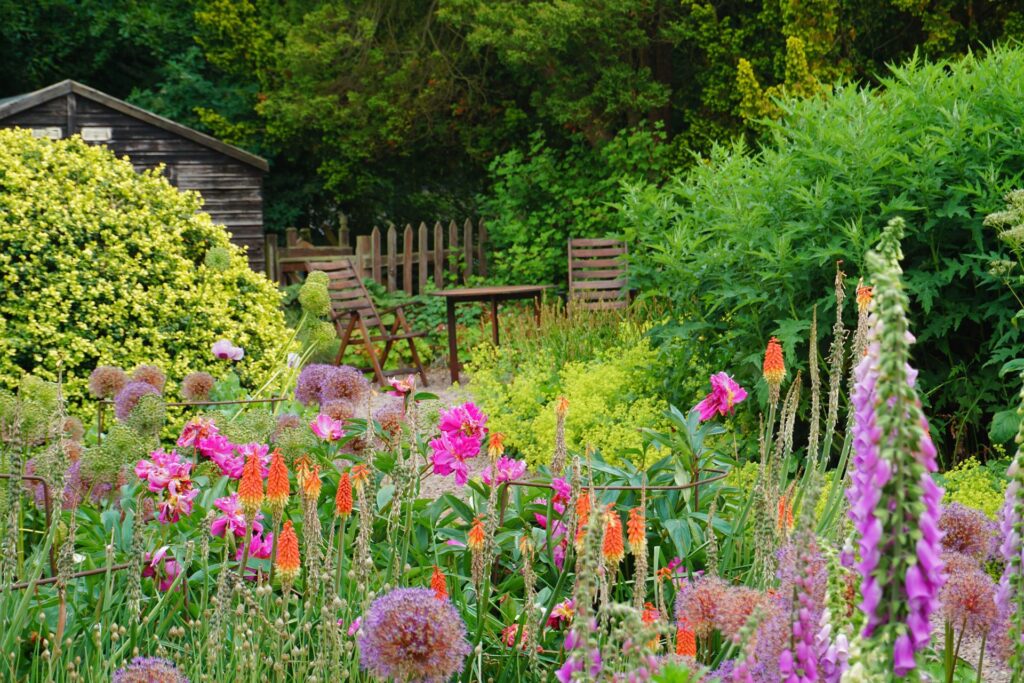
There’s often something rising above the softer planting: foxgloves, hollyhocks, delphiniums, or other tall flowering plants.
Those vertical accents are part of what makes the planting feel so exuberant.
Without them, a border can become a collection of plants sitting at roughly the same height.
I’d introduce tall flowering plants selectively, considering their mature height, growing conditions, and whether they need staking.
They can rise through lower plantings, accent a fence, or draw attention toward an entrance.
Repeat Your Favorites
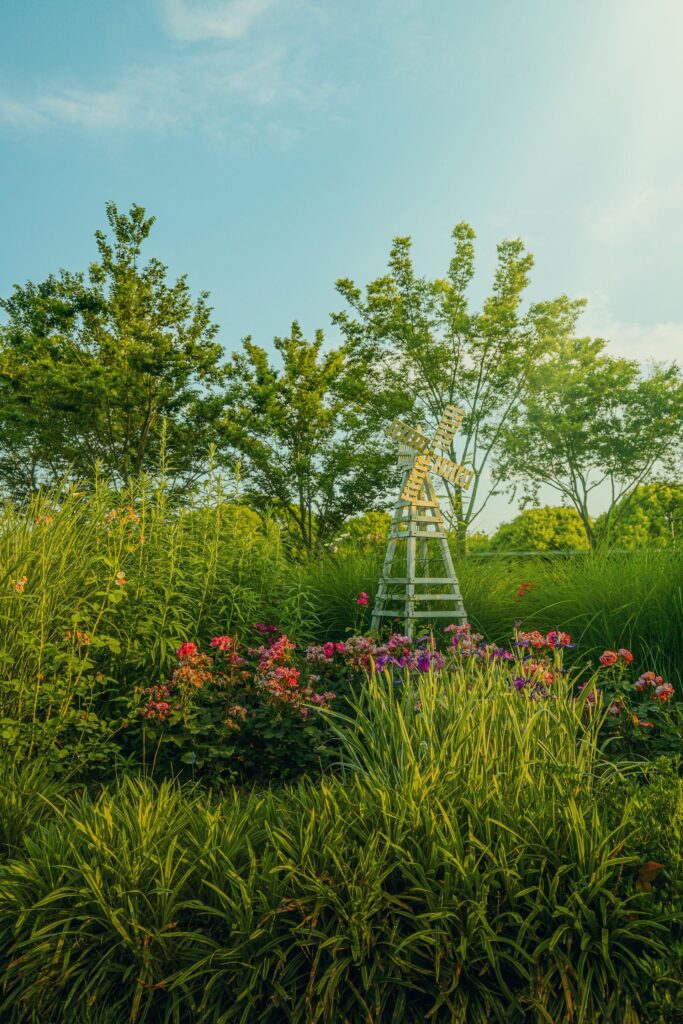
Here’s where I’d become a little more systematic.
Instead of placing every plant wherever there’s an empty spot, I’d arrange a few favorites in repeated groups.
Perhaps a grouping of salvias appears beside the walkway and again near the front entrance.
The same soft pink flowers might appear in two or three areas, with a contrasting evergreen providing structure between them.
Repetition creates a sense of connection.
And in a small garden, that can be the difference between a beautifully abundant planting and a collection of unrelated flowers.
Let a Few Plants Wander
Finally, I’d leave room for some spontaneity.
Self-seeding flowers can help give cottage gardens that wonderfully relaxed appearance.
Plants such as nigella, calendula, and certain foxgloves may return from seed when growing conditions are suitable.
You won’t always know precisely where they’ll appear.
And that’s part of the pleasure.
I’d allow a few desirable seedlings to establish themselves, editing out those that appear in inconvenient places.
That gives you a little of the wildness cottage gardens are known for without surrendering the overall design.
The result is a garden with a recognizable framework, a thoughtful planting palette, and just enough unpredictability to keep it interesting.
A Cottage Garden Is for Someone Who Loves to Garden
There’s something else worth considering before you begin.
A cottage garden isn’t necessarily a low-maintenance garden.
Those abundant flowers may need cutting back, deadheading, dividing, staking, or occasional editing. Self-seeders need watching. Vegetables require regular attention.
But for someone who genuinely enjoys gardening, that isn’t necessarily a disadvantage.
Part of the pleasure is being involved.
Noticing a seedling where you didn’t expect one. Cutting flowers for the kitchen table. Harvesting a handful of herbs on your way indoors. Moving a plant because you think it might look more beautiful somewhere else.
A cottage garden is never quite finished.
And for the right gardener, that’s exactly what makes it so appealing.
Now, Put It All Together
So what does all this look like in an actual small front yard?
Let’s consider a few different ways to arrange a cottage garden, because the layout that works beautifully for one house may not make sense for another.
Perhaps your front door is centered on the house, with just enough room for flowers on either side. Maybe your existing walkway cuts through the garden, or you’d like to make room for a little bench among the planting.
Each situation presents different opportunities.
I’ll show you three ways to approach the space, beginning with a layout I designed for a small front yard.
As you look through them, pay attention to the things we’ve already discussed: the pathways, the structure, the amount of room given to planting, and how the flowers and other plants work together.
You don’t need to copy a layout exactly. The idea is to understand why it works so you can borrow what makes sense for your own garden.
Layout 1: A Straight Path With Curved Cottage Borders
Best for: A small front yard where you want a welcoming entrance surrounded by abundant flowers.
Let’s start with a garden that’s 30 feet wide and 10 feet deep, divided by a central walkway.
That’s approximately 300 square feet before accounting for the path.
It might not sound like much, but it’s enough room for a lovely cottage garden.
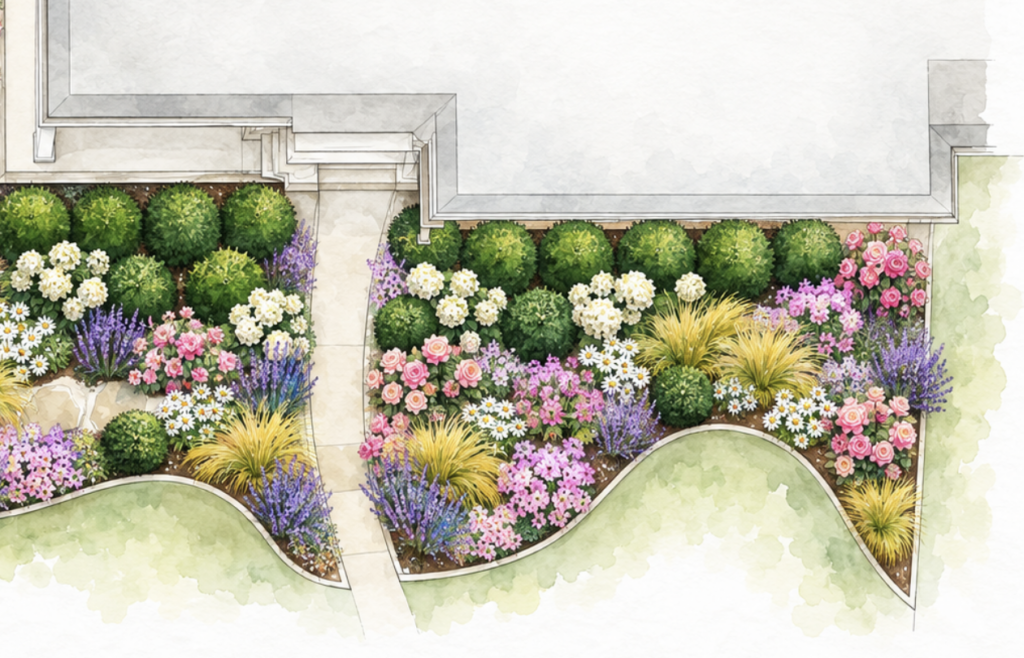
Keep the Path Simple
In this design, the path leads directly to the entrance.
It’s tempting to introduce curves everywhere when designing a cottage garden, but you don’t necessarily need a winding walkway to create that romantic, informal feeling.
A straight path is practical, particularly when visitors need an obvious route to the front door.
Instead, I’ve introduced movement through the edges of the planting beds.
Notice how the borders curve gently toward and away from the walkway.
Those curves create opportunities for deeper planting in some places and narrower groupings in others. They also soften the geometry of the house and path.
It’s a simple way to give a small garden a more relaxed appearance.
Establish the Structure
Next, look at the shrubs positioned closest to the house.
Their rounded shapes provide a steady backdrop to the flowers.
I particularly like using compact evergreens in a cottage garden because they offer something solid against all those loose, flowering plants.
They also give the garden structure during winter, when many perennials have disappeared.
You could use compact boxwoods, suitable dwarf yews, or other small shrubs appropriate for your climate.
The exact plants matter less than their role in the composition.
Let the Flowers Fill the Borders
Now we can introduce the cottage garden character.
I’d begin with three to five flowering perennials that complement one another, choosing plants with different heights, foliage textures, and flowering seasons.
Rather than scattering them randomly, I’d repeat a few combinations through both sides of the walkway.
Perhaps a cluster of salvias appears near the sidewalk and again closer to the house. Smaller flowers can soften the edges of the path, while taller perennials rise through the planting farther back.
You might include a rose near the entrance or another vertical accent if there’s sufficient space.
The goal isn’t to fit as many different plants as possible into the beds.
It’s to make a small collection of beautiful plants feel abundant.
Make the Layout Your Own
What if you’d like to grow food here?
You could tuck herbs into sunny spaces near the path or replace a few ornamental groupings with edible plants.
What if the garden receives afternoon shade?
Keep the layout, but choose a plant palette that thrives in those conditions.
And if you already have an established shrub or a small tree, you may be able to build the planting around it rather than starting over.
That’s what I like about this approach.
The structure gives you a starting point, but the planting can be entirely your own.
Layout 2: A Little Garden on Either Side of the Front Door
Best for: Very small front entrances where most of the available planting space sits directly beside the walkway.
You don’t need a large front yard to create a charming cottage garden. Sometimes a few feet on either side of the entrance are all you have.
This layout is a good example.
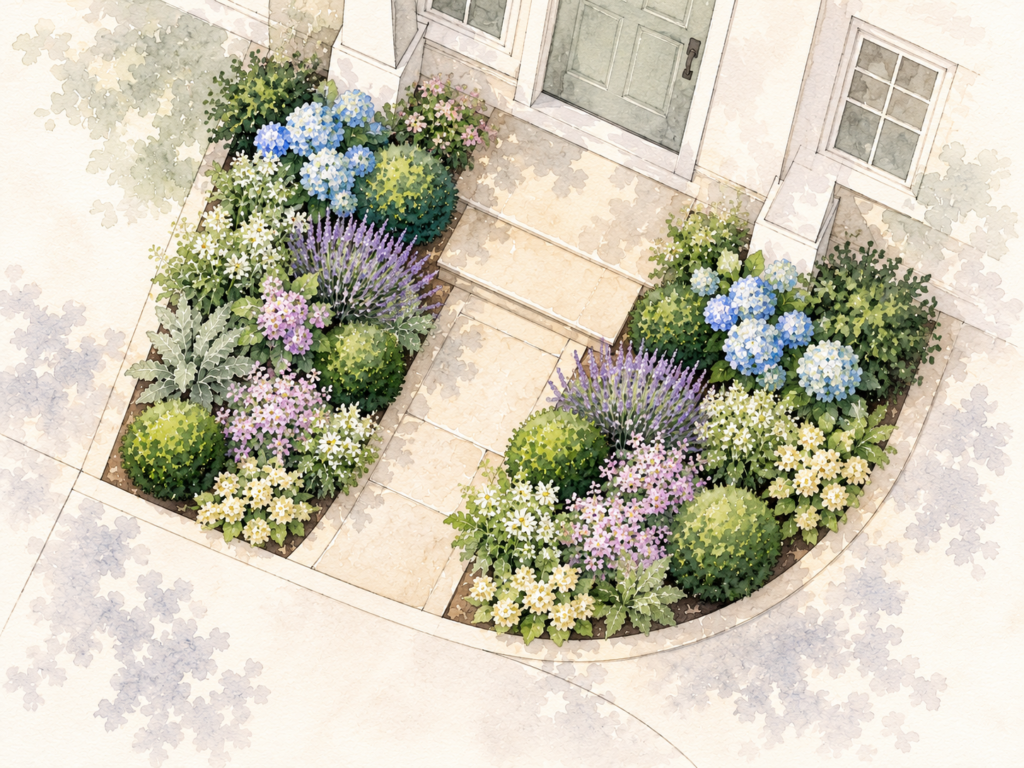
Work With the Entrance You Have
Here, the existing path and front steps establish the garden’s structure.
There’s no need to introduce another walkway or squeeze in a seating area. The purpose of this little garden is to make the arrival at the front door something lovely to experience.
Notice how the planting beds frame the entrance, with flowering plants and rounded evergreen shrubs creating a sense of abundance without overwhelming the space.
Use the House as Your Starting Point
I’d begin by considering the architecture and color of the house.
The soft blue hydrangeas in this illustration could be a beautiful choice for a shaded or partly shaded entrance, provided the selected variety suits the conditions.
Lavender-colored flowering plants, pale yellow blooms, and compact evergreen shrubs complete the composition.
The exact plants would depend on the climate and available sunlight, but the design principle stays the same: choose a few plants that complement the house and repeat their colors and shapes.
Make Every Plant Count
When the planting beds are this small, you have to be selective.
One or two compact shrubs can provide permanent structure. Flowering perennials bring seasonal interest, while lower-growing plants soften the pathway.
And don’t overlook the possibility of using just one side of the entrance if that’s all the space you have.
A beautiful little border doesn’t have to be symmetrical to feel intentional.
Layout 3: A Cottage Garden With a Place to Sit
Best for: A small front yard where you’d like to enjoy the garden rather than simply walk through it.
Of all the layouts, this one may offer the most possibilities for someone who loves spending time among her plants.
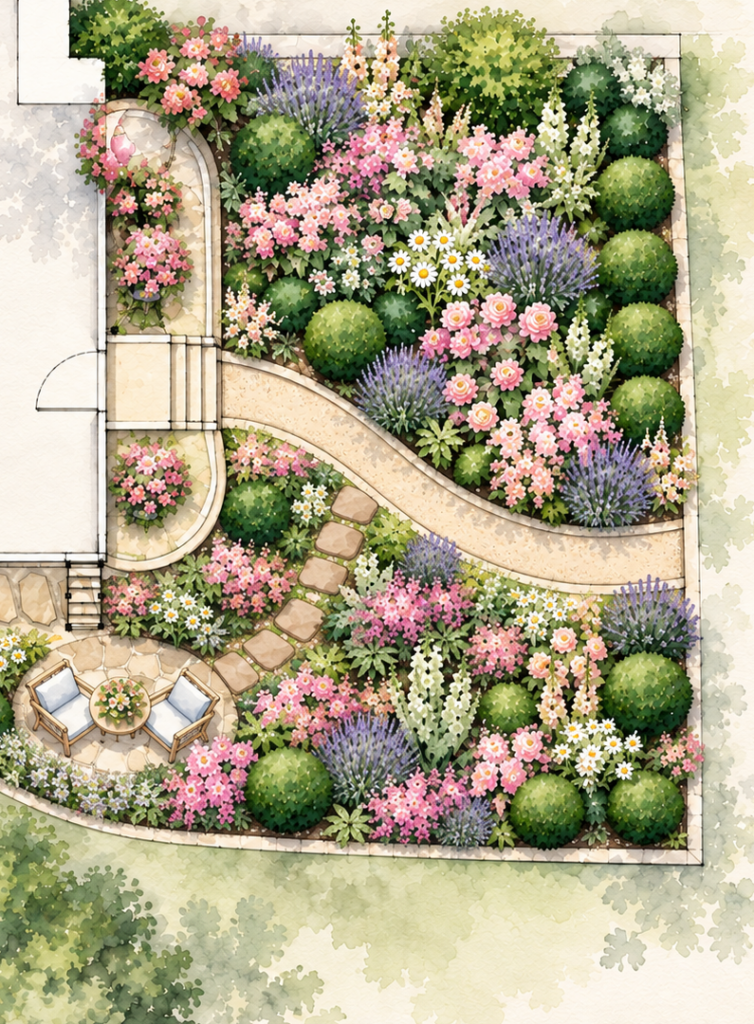
There’s a proper walkway leading to the front entrance, generous planting beds, and a small seating area tucked among the flowers.
The garden is still compact, but now it has somewhere to linger.
Give the Seating Area Its Own Little Space
Look toward the lower portion of the plan.
Two chairs and a small table create a place for morning coffee, reading, or enjoying the garden at the end of the day.
The chairs are oriented toward the house and garden walkway, so the seating feels connected to the entrance rather than turned away from it.
I’d pay close attention to the amount of room around the furniture. You need enough space to pull out a chair, sit comfortably, and move without stepping into the planting.
A little seating area can be delightful, but only if it’s actually comfortable to use.
Don’t Forget How You’ll Get There
Notice the small stepping-stone path branching off the main walkway.
This is one of my favorite details.
Rather than introducing another wide paved path, the stepping stones provide a secondary route through the planting.
They also signal that the seating area is a destination of its own.
I’d choose stepping stones with comfortable spacing and stable, level surfaces so the route is practical as well as beautiful.
It’s a small detail, but one that makes the entire garden feel more thoughtfully designed.
Create a Sense of Enclosure With Planting
I’d arrange the planting around the seating area so that it feels surrounded by the garden without being crowded.
Compact evergreens provide structure. Flowering shrubs and perennials soften the space, while taller flowers create a little separation from the rest of the yard.
You might introduce a climbing rose or clematis on a suitable support, or position a small ornamental tree where it can provide a little shade.
The idea is to make the seating area feel like a place you want to stay.
Could You Grow Food Here, Too?
Absolutely.
In fact, I’d be tempted to reserve a sunny portion of the planting for herbs and vegetables.
Perhaps you could grow thyme near the stepping stones, chives among the flowers, or leafy greens in a small dedicated section of the border.
If producing food is a major priority, you could allocate one of the larger planting areas to edible plants before selecting the ornamentals.
That’s the beauty of starting with a layout. You establish the essential spaces first, then decide what you want to grow within them.
Bonus Layout: A Cottage Garden for the Tiniest Front Entrance
Best for: A compact entrance with a short walkway and little room for anything beyond planting.
Sometimes the entire front garden is little more than a path to the door and two small planting beds.
That doesn’t mean it can’t have cottage garden character.

Let the Planting Make the Impression
In this plan, the walkway remains simple, while the planting beds introduce movement and softness.
One side provides room for a fuller arrangement of flowering shrubs, evergreens, and perennials. The narrower side offers opportunities for smaller plant groupings.
I’d begin with a few compact evergreen shrubs, positioning them where their rounded shapes will remain visible throughout the year.
Then I’d introduce a restrained selection of flowering plants.
A small rose, lavender-colored flowering spikes, and low-growing flowers could make a lovely combination where growing conditions permit.
Think About the View From the Street
In a garden this small, the entire composition is likely to be visible at once.
That’s why I’d be especially careful about the size and positioning of the plants.
I wouldn’t want an oversized shrub obscuring the entrance or flowers spilling so far over the walkway that visitors have to step around them.
Instead, I’d use differences in height, foliage texture, and flower shape to create interest.
The result can still feel abundant and romantic, even with relatively few plants.
And that’s something worth remembering: a cottage garden doesn’t have to occupy an entire yard. Sometimes a beautifully planted entrance is enough.
Which Cottage Garden Layout Is Right for You?
The best layout isn’t necessarily the one with the most flowers or the most elaborate pathway.
It’s the one that suits your space and the way you want to use it.
If you have a traditional front yard with an existing walkway, Layout 1 shows how curved planting borders can bring softness and movement to a simple approach.
Layout 2 demonstrates how repeated planting can create a welcoming composition, iff there is only a little space beside your entrance.
And if having somewhere to sit among the flowers appeals to you, Layout 3 shows how to accommodate that without sacrificing the journey to the front door.
And if your entrance is particularly compact, the bonus layout offers a starting point for making a small planting area feel special.
None of these plans needs to be copied plant for plant.
Your soil, sunlight, climate, available space, and personal taste will determine the planting palette.
What matters is understanding the design decisions behind each layout so you can borrow the ideas that work in your own garden.
How Much Space Should You Allow?
Before adapting any of these layouts to your own garden, get out a tape measure.
You don’t need expensive design software to get started. A pencil, some graph paper, and a few measurements will get you surprisingly far.
Begin with the dimensions of your front yard, the location of the entrance, and anything that needs to stay. Then consider how much room each feature will require.
Here are some measurements I’d use as starting points.
| Garden feature | Space to consider |
|---|---|
| Main pathway | Around 3 feet wide for comfortable single-person access |
| Cottage planting border | Approximately 2–4 feet deep where space allows |
| Small bench | The bench’s dimensions, plus room for your legs and comfortable access |
| Small bistro table | Enough room for the table, chairs, and pulling those chairs out |
| Front entrance | Clearance for doors, gates, and comfortable passage |
| Stepping-stone path | Evenly spaced, stable stones positioned for a natural walking stride |
| Edible planting area | Enough room to reach, tend, and harvest your plants |
These are starting points, not universal requirements. Your garden may need different dimensions depending on accessibility, local regulations, and how you intend to use the space.
And there’s one measurement I’d never overlook: the mature size of your plants.
That little shrub in a one-gallon nursery pot might eventually grow four feet wide. A climbing rose could need considerably more room than you imagined.
Give your plants enough space to develop naturally without constantly cutting them back to keep the walkway clear.
A little planning now will save you quite a bit of frustration later.
Don’t Forget About Winter
Here’s an exercise I like to do when designing a garden.
Imagine every flower has finished blooming and the leaves have fallen.
What’s left?
Can you still appreciate the shape of the walkway? Are there evergreen shrubs holding the planting together? Does that little bench still look inviting?

A cottage garden doesn’t need to be spectacular every day of the year. But I do think it should have something beautiful to offer in every season.
This is where the structure you established at the beginning becomes especially important.
Evergreen shrubs provide shape when the perennials have disappeared. Ornamental grasses, interesting branches, and the seedheads of certain perennials can bring texture and movement to the winter garden.
Even the features that have nothing to do with plants become more noticeable.
A lovely stone walkway, a little picket fence, or an arbor framing the entrance can be just as charming in January as it is in June.
In fact, winter is often when you can best appreciate the bones of a garden.
A Few Things I’d Avoid in a Tiny Cottage Garden
Cottage gardens are very forgiving, but there are a few things I’d be careful about when working with a small front yard.
1. Trying to fit every lovely idea into one space.
A bench, vegetable patch, birdbath, fountain, rose arbor, and dining table might all sound wonderful.
But a 15 × 15-foot front garden probably can’t accommodate all of them comfortably.
Decide what matters most to you.
If growing food is a priority, give it the space it deserves. If you’ve always imagined sitting outside among the flowers, make room for that little bench.
You don’t need everything to make a garden feel complete.
2. Filling every available inch with plants.
I love a garden that feels full and abundant. But there’s a difference between beautifully layered planting and overcrowding.
Plants need room to grow, and you need enough space to move between them, tend them, and enjoy them.
Allow some flowers to spill over the edges of the path, but don’t let them swallow it entirely.
A little breathing room can make the surrounding planting look even more beautiful.
3. Choosing plants before understanding your growing conditions.
It’s easy to fall in love with a beautiful plant at the nursery.
But if it requires full sun and your front garden spends most of the afternoon in shade, it’s probably not the right choice.
Before buying anything, understand how much sunlight your garden receives, what your soil is like, how well it drains, and which plants are suited to your climate.
Then choose the roses, shrubs, herbs, and flowering perennials that will thrive there.
Remember, you’re not simply trying to recreate someone else’s beautiful garden. You’re creating one that works in your own space.
Now It’s Your Turn
We’ve looked at four different ways to arrange a small front cottage garden.
One keeps the walkway straight and introduces movement through curved planting borders. Another makes room for a little seating area among the flowers. The others show how much character you can create around even the smallest entrance.
The purpose of these layouts isn’t to give you four gardens to copy exactly.
It’s to help you see what’s possible in your own front yard.
So before you head to the nursery, spend a little time outside.
Look at the front of your house. Notice where the sun falls throughout the day. Think about the entrance, the existing pathway, and the plants or structures you’d like to keep.
Then ask yourself what you’d most enjoy having there.
Perhaps you’d love to walk through a little garden overflowing with roses and perennials on your way to the front door.
Maybe you’d like to grow fresh herbs and vegetables among the flowers.
Or perhaps a little bench surrounded by fragrant plants would give you a reason to spend more time outside.
Once you know what you want, take your measurements and begin sketching.
Borrow the curved borders from one layout, the seating arrangement from another, or the compact planting ideas from the smallest entrance garden.
Choose the elements that suit your home, your growing conditions, and the way you want to use the space.
And remember, a cottage garden is never quite finished.
That’s part of its charm.
A flower appears somewhere you didn’t expect. A climbing rose finally reaches the top of its support. You discover that the little bench you almost didn’t include has become your favorite place for morning coffee.
Over time, the garden becomes increasingly your own.
And that’s the loveliest part of creating a cottage garden.
It’s not just something beautiful to look at. It’s a place you get to enjoy, tend, and make your own, season after season.
Continue reading: Small Front Garden Design: A Beginner’s Guide to Creating a Beautiful Welcome


