While I was working on Issue 03 of alcove, The Mediterranean Courtyard and thinking about French country garden design, I interviewed an American who now lives in Provence. We were talking about the gardens he’d come to know after living there for years when he said something almost in passing.
“The shutters and rose pairings aren’t accidental.”
That stayed with me.
Once someone points out something like that, you can’t stop seeing it.
Also Explore:
How to Make Your Garden Feel Like The South of France
We tend to think of gardens as something separate from the house they’re planted around. We choose flowers because we like them, shrubs because they fill a space, vines because we need to soften a wall. The house is one project, the garden is another. But as I looked back through photographs I’d taken in the South of France, I realized the French rarely seem to think that way. The roses aren’t simply growing beside the house; they’re completing it.
The gardens aren’t highly manicured here in the way many people expect French gardens to be. These aren’t Versailles, with hedges clipped into submission and every shrub held perfectly in place, but places where roses spill where they want to spill, climbers wander across old walls, lavender leans into pathways, and things are allowed to breathe a little. The gardens feel relaxed, but that doesn’t mean they’re random. The restraint is simply happening somewhere else.
{KEEP READING TO LEARN ABOUT FRENCH COUNTRY GARDEN DESIGN AND WHY FRENCH SHUTTERS & CLIMBING ROSES ARE NEVER AN ACCIDENT}

Morgane Le Breton
Why French Shutters and Climbing Roses Look So Good Together
I went back through my photographs, this time paying less attention to the flowers themselves and more attention to what they were growing against.
The pattern became impossible to ignore.
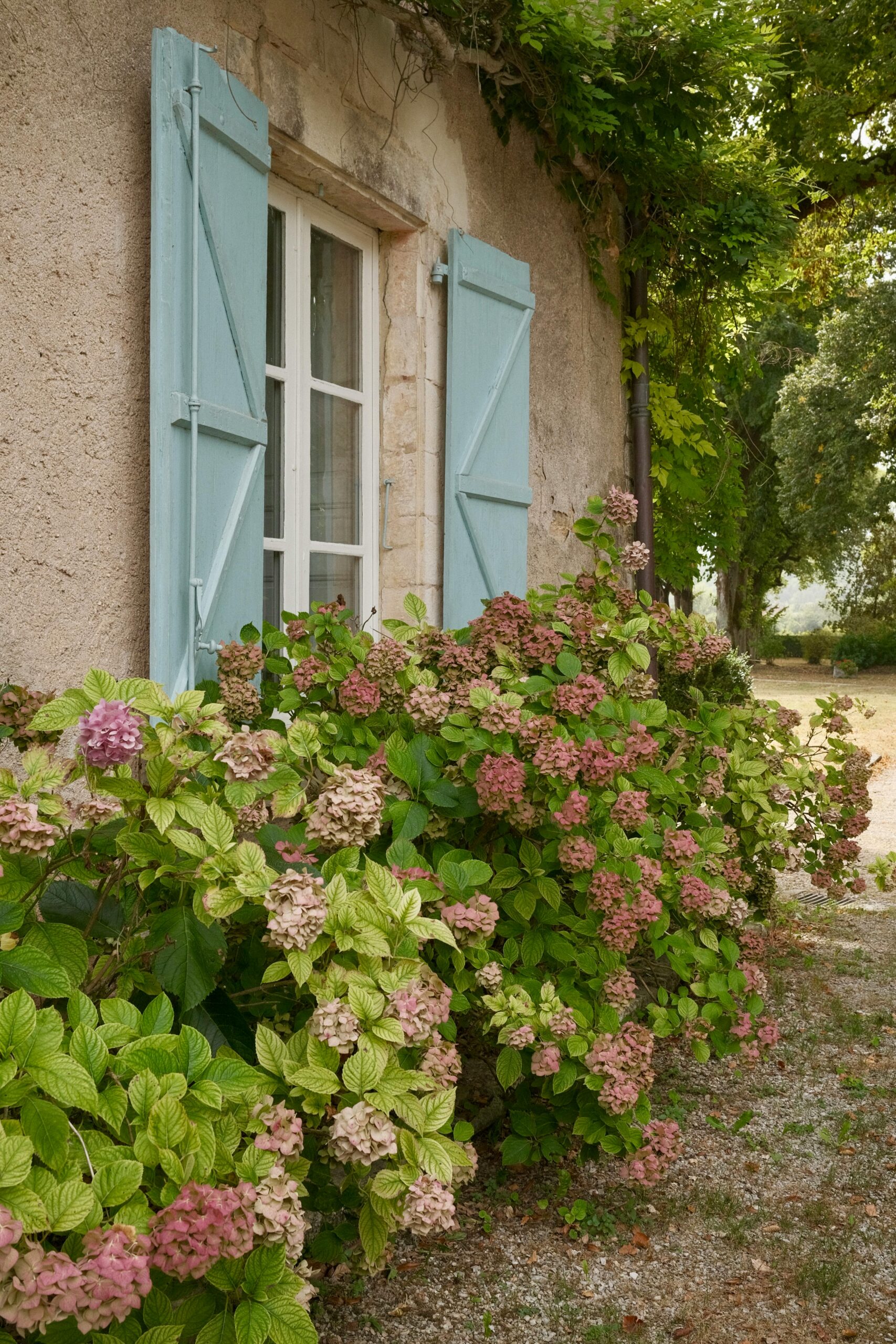
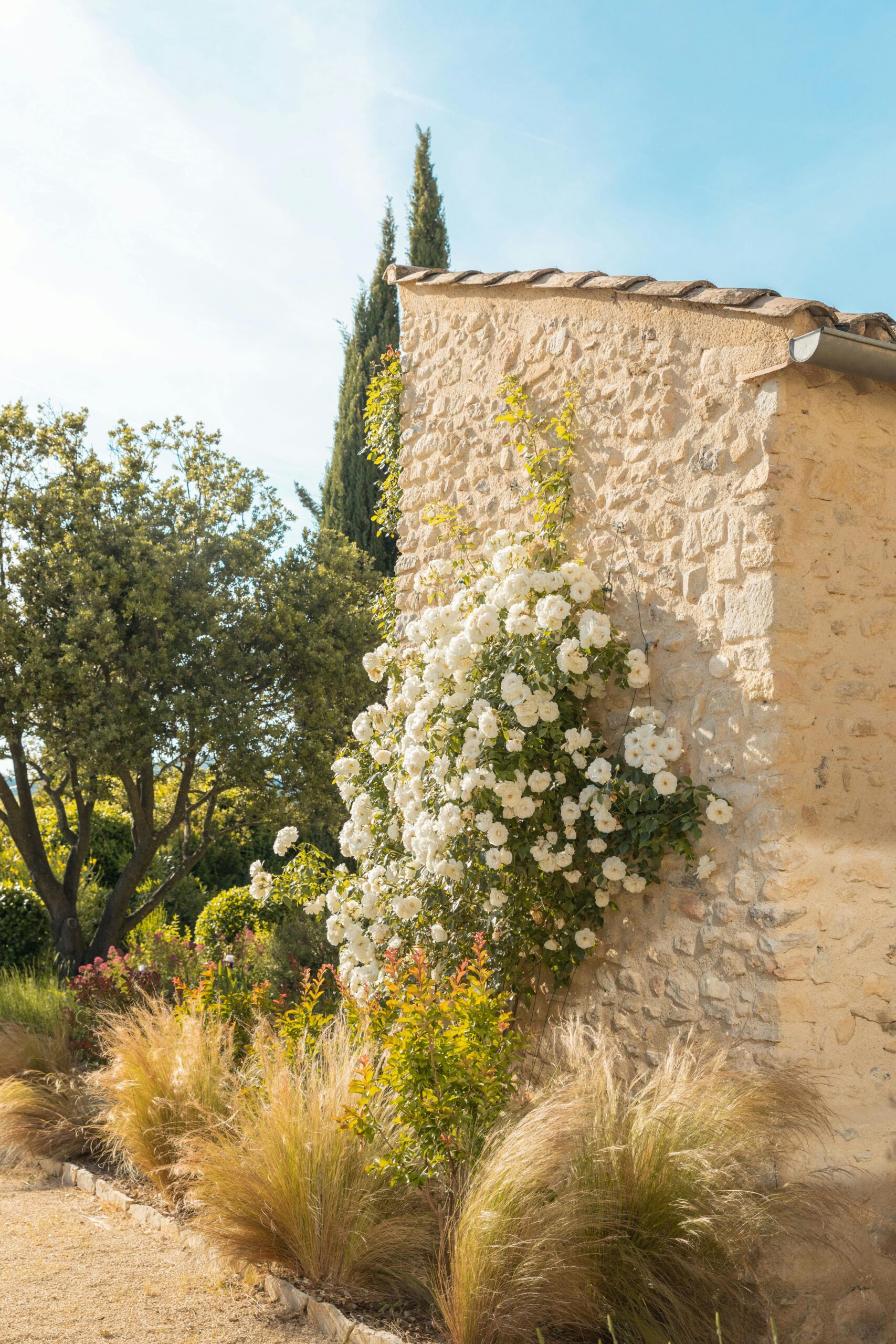
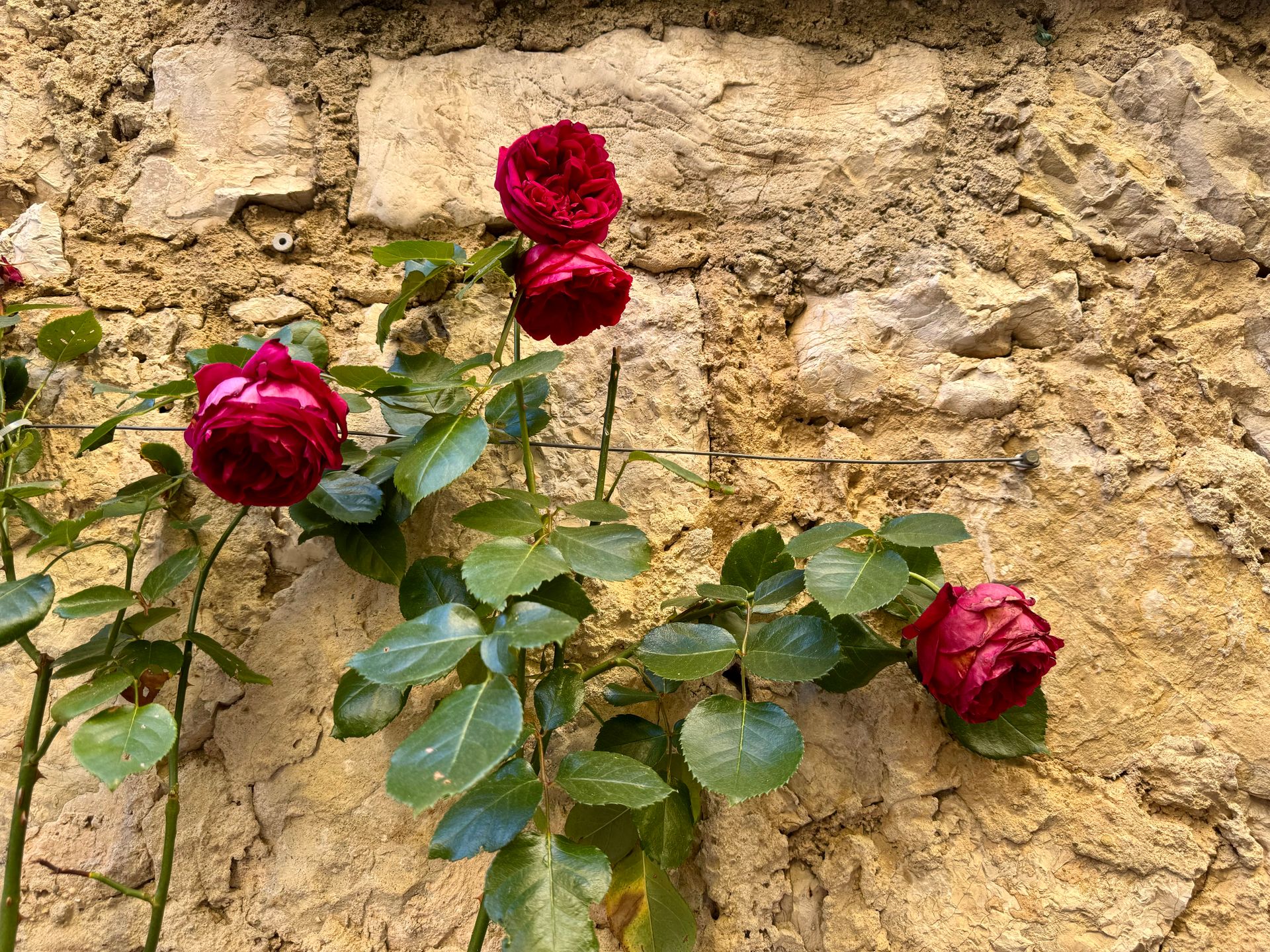
The pale blue shutters weren’t paired with bright yellow roses. Instead, they sat beside soft blush flowers that echoed the faded paint. Weathered limestone walls became the perfect backdrop for deep crimson blooms, their warmth making the reds feel richer instead of louder. Elsewhere, turquoise shutters were surrounded by coral roses, while creamy plaster walls carried climbing roses in shades that almost disappeared into the façade.
None of these combinations demanded attention.
They simply felt right.
And I think that’s exactly why they stay with us.
The House and Garden Are Designed Together
I think this is where many of us accidentally separate the garden from the architecture.
We repaint the shutters because the paint has faded. Months later, we choose a rose because we like the flower. Both decisions are perfectly reasonable, but they’re unrelated.
In Provence, they often seem connected.
The house isn’t simply a backdrop for the planting. The planting becomes another material, every bit as important as the shutters, the stone, the limewashed walls, or the terracotta roof. Once you begin thinking this way, even a single climbing rose becomes less about the flower itself and more about the relationship it’s creating with everything around it.

Christine Ellsay, Villeneuve-lès-Avignon, France
How to Recreate This French Garden Idea at Home
The lovely thing about this observation is that you don’t need French shutters to borrow the idea.
You don’t even need climbing roses.
The lesson is simply to ask one more question before planting.
What is this flower sitting beside?
Is it warming the color of the stone? Softening painted wood? Picking up a color that’s already present in the house? Providing contrast where the façade feels flat?
The answer doesn’t need to be dramatic. In fact, it probably shouldn’t be. The gardens that stay with us rarely rely on one spectacular decision. They rely on dozens of small ones that reinforce each other until the entire place feels harmonious.
The more time I spend looking at gardens in the South of France, the less I think their beauty comes from lavender fields or centuries-old stone farmhouses, although they help. I think it also comes from relationships.

A shutter and a rose.
A stone wall and a climbing vine.
A faded door and the flowers planted beside it.
Individually, none of them would take your breath away. But together, they create something that’s surprisingly difficult to explain, and almost impossible to forget.
Garden Readings
Garden Reading 01

Micheile Henderson
The pairing here isn’t about contrast, it’s about harmony. The mint shutters, the blush roses, the warm stone: everything sits in the same soft, cool register. Nothing is yelling notice me. The ivy spilling over the roofline is part of the same decision, connecting the building to the planting so gradually that the garden appears to have simply grown there over time.
Garden Reading 02
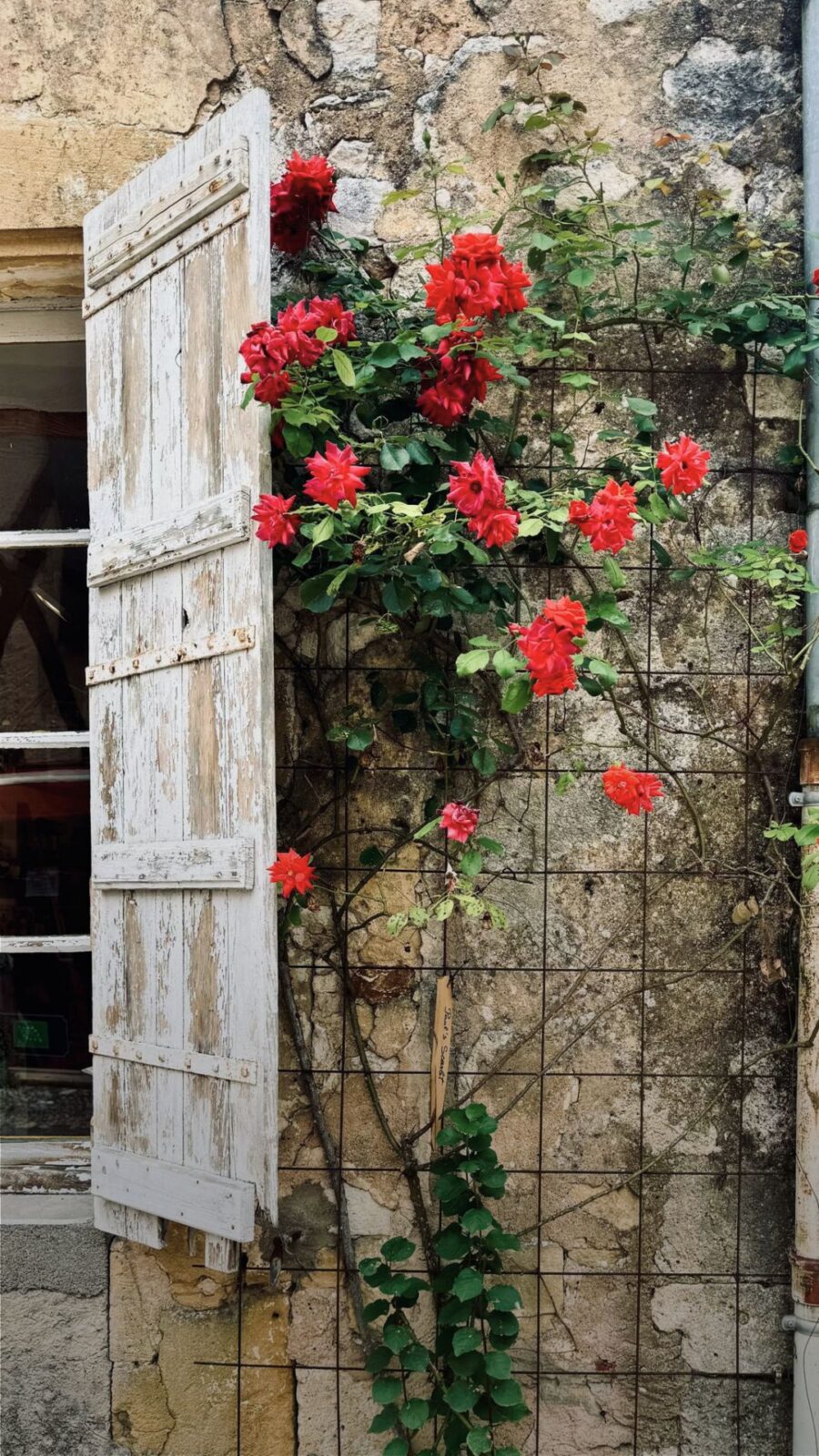
Abigail Boucker
Look at the wire grid before you look at the rose. The rose appears to sprawl freely across the wall, blooming in every direction. But the canes are trained along a structure that was installed before any plants went in. The wildness is real and the framework underneath it was deliberate.
Garden Reading 03

Nur Demirbaş
Here the climbing plant and the plaster wall are nearly the same tone — warm, neutral, each receding into the other. The shutter color is the only decision that needed to be made. Everything else was allowed to settle around it.